
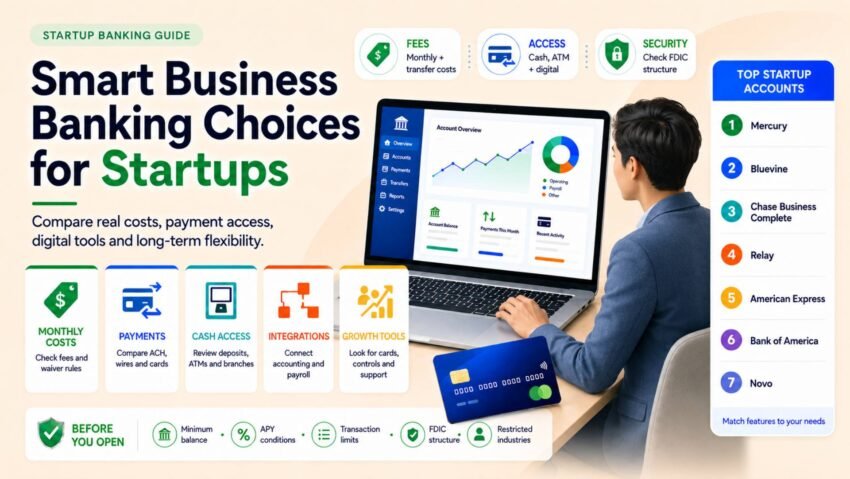
Separating business and personal finances gives a startup cleaner bookkeeping records, clearer cash-flow visibility, and more defensible documentation at tax time. A dedicated account can also make it easier to manage vendor payments, payroll, investor funds, and business expenses.
However, the account with the lowest advertised fee is not automatically the best startup business bank account. Founders must also consider wire charges, payment limits, cash-deposit costs, software connections, customer support, account eligibility, and deposit-insurance arrangements.
This comparison covers accounts available to businesses in the United States. We evaluated costs, payment capabilities, cash access, accounting integrations, security, support, and the ability of each account to accommodate a growing company.
Editorial Disclosure
To build this comparison, we reviewed information from provider pages, fee schedules, account disclosures, help centres, and FDIC information. Rankings reflect defined editorial criteria rather than promotional claims.
Fees, APYs, promotions, eligibility requirements, partner-bank arrangements, and account features can change. Readers should verify current terms directly with each provider before applying. This article provides general information—not individualized financial, legal, or tax advice—and inclusion does not guarantee approval.
Key Takeaways
- Match the account to how the startup receives, holds, and spends money—not simply its advertised monthly fee.
- Review wire, accelerated ACH, ATM, cash-deposit, check, and foreign-exchange charges.
- Mercury, Bluevine, Relay, and Novo are fintech companies, not banks.
- Confirm which bank holds the deposits and whether pass-through FDIC insurance conditions apply.
- Check compatibility with accounting, payroll, ecommerce, invoicing, and payment platforms.
- Consider future employee access, payment volume, reserves, financing, and support requirements.
- Read the complete fee schedule and deposit agreement before applying.
How the Seven Accounts Were Selected
A broad group of digital platforms, national banks, regional institutions, and specialist business accounts was assessed. The final choices represent seven distinct startup requirements: digital-first operations, interest earnings, branch access, cash deposits, budgeting controls, straightforward rewards, and freelancer-friendly integrations.
Mercury earned a place for incorporated technology and venture-backed companies. Bluevine represents interest-bearing digital checking, while Chase and Bank of America provide branch access and broader banking relationships. Relay was selected for cash-flow organization, American Express for uncomplicated interest and rewards, and Novo for freelancers and online businesses.
Alternatives considered included Axos, Capital One, Grasshopper, Brex, Found, North One, and U.S. Bank. These can suit particular businesses, but they did not make the final seven because their eligibility models, geographic availability, pricing structures, cash capabilities, or specialist positioning were less suitable for this broad startup comparison. Their exclusion should not be interpreted as evidence that they are poor accounts.
Startup Business Bank Accounts: Quick Comparison
| Account or Provider | Best For | Monthly Fee | APY | Cash Deposits | Rating |
|---|---|---|---|---|---|
| Mercury | Incorporated startups | $0 | 0% on checking | No | 9.0/10 |
| Bluevine Standard | Interest-bearing checking | $0 | 1.30% with qualifying activity | Yes, with fees | 8.8/10 |
| Chase Business Complete | Branch and cash access | $15; waivable | None | Yes | 8.6/10 |
| Relay Starter | Budgeting and subaccounts | $0 | 1.11% on savings | Limited | 8.5/10 |
| American Express Business Checking | Straightforward interest | $0 | 1.30% up to $500,000 | No | 8.3/10 |
| Bank of America Fundamentals | Branch-based businesses | $16; waivable | None | Yes | 8.1/10 |
| Novo Business Checking | Freelancers and ecommerce | $0 | None | No | 8.0/10 |
Editorial Recommendation
- Best overall: Mercury
- Best no-monthly-fee option: Bluevine Standard
- Best for cash-based businesses: Chase Business Complete Banking
- Best for incorporated or venture-backed startups: Mercury
- Best for earning interest: Bluevine, subject to plan and qualification requirements
Account Terms Note
Fees, APYs, eligibility rules, partner-bank arrangements, deposit limits, sweep networks, and promotional offers may change. APYs are variable unless a provider explicitly states otherwise.
The Best Business Bank Accounts for Startups
1. Mercury — Best for Incorporated and Venture-Backed Startups
Overview
Mercury is a financial technology company, not an FDIC-insured bank. Banking services are provided through Choice Financial Group and Column N.A., both FDIC members, with eligible deposits potentially distributed through sweep-program banks.
Its core banking service is designed for technology companies, funded startups, ecommerce businesses, and other incorporated firms that primarily move money electronically. Mercury ranks first because its payment tools, user permissions, account organization, and startup-oriented interface work particularly well together.
The main limitation is physical banking. Mercury does not provide conventional branches or direct cash deposits, and its eligibility model excludes some business types, including sole proprietorships.
Key Account Features
- No monthly fee for core checking and savings
- No minimum opening deposit or ongoing balance
- Free standard and same-day ACH transfers
- Free domestic and USD international wires
- A 1% currency-exchange fee for supported non-USD wires
- Virtual and physical cards with customizable controls
- Team permissions and payment-approval policies
- Invoicing, bill payment, and expense-management tools
- QuickBooks and Xero accounting connections
- No direct cash-deposit service
Mercury’s official pricing information should be reviewed for paid workflow features and transaction-specific charges.
Pros
- No monthly fee for core banking
- Free ACH and USD wire payments
- Strong employee permissions and approval controls
- Multiple checking and savings accounts
- Startup-oriented invoicing and expense tools
- Extended potential FDIC coverage through partner-bank sweep networks
Cons
- No physical branches
- Cash deposits are not supported
- Sole proprietorships are generally ineligible
- Standard checking does not pay interest
- Certain advanced workflows require a paid plan
Fees and Account Requirements
Mercury’s core account has no monthly maintenance fee, opening-deposit requirement, minimum balance, or overdraft fee. Standard ACH, same-day ACH, domestic wires, and international wires sent in US dollars are listed as free.
International wires involving currency conversion carry a 1% exchange fee. Card transactions and specialized services may have separate costs, while advanced invoicing and financial workflows are available through paid plans.
APY and Deposit Earnings
Standard Mercury checking is non-interest-bearing. Its current Choice Financial Group deposit agreement identifies a 0.00% APY for the standard deposit account.
Mercury offers separate savings and treasury-related yield options, but availability, rates, eligibility, and risk characteristics differ. Founders should not treat an investment or treasury product as equivalent to an FDIC-insured checking deposit.
Payments, Deposits, and ATM Access
Mercury is particularly effective for startups paying contractors, software vendors, and international suppliers electronically. Free ACH and USD wires can deliver meaningful savings for companies that regularly make high-value transfers.
Mobile check deposits and mailed checks are available, but physical cash deposits are not. Startups receiving cash should choose Chase, Bank of America, or Bluevine—or maintain a second account specifically for cash handling.
Integrations and Financial Tools
Documented tools include QuickBooks and Xero connections, bill payment, invoicing, spend management, cards, reimbursement workflows, and team permissions. These functions can reduce the need to combine several basic financial applications.
For startups connecting business bank feeds with cloud accounting software, Megri Accounting highlights the importance of coding transactions consistently and reconciling bank, card, payroll, and payment-platform balances each month. This process helps founders maintain accurate cash-flow forecasts, tax reserves, and management reports as transaction volumes increase.
Ease of Opening and Using the Account
Applications are completed online. Companies should expect to provide formation documents, an EIN, ownership information, a US business address, and information about business activities and anticipated transactions.
Mercury can support some US companies founded by non-US residents, but eligibility depends on country, ownership, industry, and verification requirements. Approval should never be assumed.
Security and FDIC Insurance
Mercury is not itself FDIC-insured. Eligible deposits are held through Choice Financial Group, Column N.A., and participating sweep banks. Mercury states that qualifying customers may receive up to $5 million in aggregate FDIC coverage, subject to program conditions and any deposits the customer already holds at participating banks.
The Mercury FDIC disclosure explains the partner-bank arrangement. Security features include passkeys, account alerts, card controls, user permissions, and payment approvals.
Best For
Mercury is best for incorporated, digitally operated startups with regular ACH or wire activity and little or no cash revenue. It is especially relevant to software, technology, ecommerce, consulting, and venture-backed companies.
Sole proprietors, cash-intensive companies, and founders who value in-person service should consider another account.
Best Alternative
Relay is the strongest alternative when a startup needs more granular budgeting accounts and bookkeeping workflows. Chase is preferable when branches and cash deposits are essential.
Editor’s Take
Mercury’s primary advantage is not merely free checking. It is the combination of payment capabilities, account controls, and startup-oriented administration.
Compared with Bluevine, Mercury offers stronger USD wire economics and a more specialized experience for incorporated startups. Bluevine, however, supports cash deposits and can pay interest directly on qualifying checking balances.
Relay provides more explicit cash-flow segmentation, while Mercury is stronger for investor-funded companies and international USD payments. The absence of cash deposits remains material, but it is unlikely to affect a digital-only startup.
Mercury earns first place because its core benefits remain valuable after the restrictions are considered. It is not universal, but it is the most complete option for the audience it is designed to serve.
Ratings
| Category | Score |
|---|---|
| Fees and Value | 9.6 |
| Account Features | 9.4 |
| Payments and Transfers | 9.7 |
| Cash and ATM Access | 5.7 |
| Integrations | 9.3 |
| Ease of Use | 9.1 |
| Security and Deposit Protection | 9.2 |
| Scalability and Support | 9.0 |
| Overall Score | 9.0/10 |
2. Bluevine Business Checking — Best for Interest-Bearing Digital Checking
Overview
Bluevine is a fintech company, not a bank. Banking services are provided through Coastal Community Bank, Member FDIC, with eligible deposits potentially placed at program banks.
Bluevine Standard combines no monthly fee with checking interest, subaccounts, payment tools, and cash-deposit access. It ranks second because it serves a wider range of small businesses than many digital-only competitors.
Its principal limitation is that Standard customers must complete qualifying activity to earn the advertised APY. Cash deposits are supported, but they carry network fees and limits.
Key Account Features
- $0 monthly fee for Standard
- No minimum opening deposit
- 1.30% APY on qualifying balances up to $250,000
- Free standard ACH transfers
- Up to five subaccounts with Standard
- MoneyPass surcharge-free ATM access
- Cash deposits through Allpoint+ ATMs and Green Dot retailers
- Bill payment, invoicing, and accounting connections
- Paid Plus and Premier plans with higher APYs and benefits
Pros
- No monthly maintenance fee on Standard
- Potential interest on checking balances
- Cash-deposit options
- Unlimited everyday transactions
- Multiple subaccounts
- Live customer-support options
Cons
- Standard APY requires qualifying monthly activity
- No interest is paid above the applicable balance cap
- Cash deposits carry fees
- Out-of-network ATM transactions can cost extra
- Higher APYs require paid plans
Fees and Account Requirements
Standard has no monthly maintenance or overdraft fee. Plus and Premier carry monthly fees that may be waived by meeting current balance and debit-card spending requirements.
Green Dot deposits can cost up to $4.95 each. Allpoint+ deposits cost $1 plus 0.5% of the deposit amount. Bluevine’s fee information lists additional payment and account-service charges.
APY and Deposit Earnings
Standard customers can earn 1.30% APY on balances up to $250,000 when they meet at least one monthly activity requirement. These generally involve eligible debit-card spending or qualifying customer payments, but founders should verify the current thresholds.
Plus and Premier offer higher APYs, with Premier advertising up to 3.00% on eligible balances. Rates are variable, plan fees can reduce net earnings, and balances above the specified cap may not earn interest.
Payments, Deposits, and ATM Access
Bluevine supports standard ACH, wires, checks, mobile check deposits, bill payment, debit cards, and invoicing. It offers surcharge-free withdrawals through the MoneyPass network.
Cash acceptance makes Bluevine more flexible than Mercury, American Express, or Novo. Nevertheless, per-deposit fees and limits can become expensive for restaurants, shops, and service companies receiving cash every day.
Integrations and Financial Tools
Bluevine documents connections with QuickBooks and several payment and finance tools. Subaccounts can be used to separate payroll, operating costs, taxes and reserves without opening accounts at different institutions.
Ease of Opening and Using the Account
The application is online. Applicants should prepare an EIN or Social Security number where appropriate, formation details, ownership information, business address, and identification.
Supported structures include common small-business entities and sole proprietorships, subject to Bluevine’s eligibility and industry restrictions.
Security and FDIC Insurance
Bluevine is not an FDIC-insured bank. Deposits are held through Coastal Community Bank and program banks.
Bluevine advertises potential FDIC protection of up to $3 million for eligible deposits distributed through its program. Pass-through coverage depends on accurate records, program participation, ownership capacity, and the customer’s other deposits at each receiving bank.
Best For
Bluevine is best for founders who want no-fee digital checking, moderate cash access, subaccounts, and potential interest. Companies depositing large quantities of cash should consider Chase instead.
Best Alternative
American Express Business Checking is a useful alternative for founders who want a straightforward checking APY without Bluevine’s Standard monthly activity conditions.
Editor’s Take
Bluevine delivers one of the strongest combinations of yield, payments, and accessibility. It is more accommodating than Mercury for sole proprietors and businesses occasionally receiving cash.
Its headline APY requires careful reading. A founder who misses the monthly qualification or holds funds above the cap may earn less than expected.
American Express offers a simpler interest model, while Relay provides more developed cash-flow segmentation. Neither matches Bluevine’s combination of no-fee checking, qualifying interest, and cash-deposit access.
Bluevine ranks second because it is broadly useful, but founders should calculate cash fees and APY qualification before choosing it.
Ratings
| Category | Score |
|---|---|
| Fees and Value | 9.4 |
| Account Features | 9.2 |
| Payments and Transfers | 8.8 |
| Cash and ATM Access | 8.1 |
| Integrations | 8.7 |
| Ease of Use | 9.0 |
| Security and Deposit Protection | 9.0 |
| Scalability and Support | 8.3 |
| Overall Score | 8.8/10 |
3. Chase Business Complete Banking — Best for Branch and Cash Access
Overview
JPMorgan Chase Bank, N.A. is an FDIC-insured bank. Business Complete Banking combines branches, ATMs, electronic payments, cash deposits, and integrated card acceptance.
The account ranks third because it gives cash-handling startups a more complete banking relationship than most fintech platforms. Its main drawback is the $15 monthly fee when waiver conditions are not met.
Key Account Features
- $15 monthly fee, with several waiver routes
- No minimum opening deposit
- Branch and Chase ATM access
- Up to $5,000 in branch cash deposits per cycle without processing fees
- Unlimited electronic deposits
- Built-in QuickAccept card acceptance
- Zelle for eligible business payments
- Mobile deposits and online bill payment
- Access to business credit and savings products
Pros
- Large branch and ATM network
- Practical cash and check deposits
- Multiple methods of waiving the monthly fee
- Integrated card acceptance
- Broader lending and merchant-service relationship
- Direct FDIC-insured bank account
Cons
- $15 fee if waiver conditions are missed
- Limits apply to included teller transactions
- Cash-processing fees apply above the allowance
- Domestic and international wires can be expensive
- Checking does not provide a meaningful APY
Fees and Account Requirements
The monthly fee is $15 but can be waived through a qualifying balance, eligible card purchases, Chase Payment Solutions deposits, or other published relationship criteria. No minimum opening deposit is required.
The first $5,000 of cash deposited at a branch during a statement cycle carries no cash-processing fee; amounts above the allowance are generally charged 0.30%. Chase ATM cash deposits do not carry the same processing charge, although limits and availability apply. Founders should consult the Chase business fee schedule.
APY and Deposit Earnings
Business Complete Banking is not designed as an interest-bearing checking account. Startups seeking earnings on operational cash should compare Bluevine or American Express, or use a separate business savings account.
Payments, Deposits, and ATM Access
Chase supports ACH payments, wires, checks, cash, mobile deposits, debit cards, ATMs, Zelle, and merchant card acceptance. The breadth of these options makes it suitable for a hybrid startup accepting both digital and in-person payments.
Integrations and Financial Tools
Chase provides QuickBooks connectivity, online bill payment, invoicing, payment acceptance, account alerts, and access to related credit and cash-management services.
Ease of Opening and Using the Account
Some businesses can apply online, while more complex structures may need to visit a branch. Required documents vary by entity and can include formation documents, an EIN, assumed-name documentation, ownership details, and personal identification.
Security and FDIC Insurance
Deposits held directly at JPMorgan Chase Bank are FDIC-insured within standard legal limits. Business accounts owned by the same entity at the bank are generally aggregated within the applicable ownership category.
Security features include account alerts, check monitoring, card controls, multifactor authentication, and additional fraud-management services.
Best For
Chase is best for retail, hospitality, personal-service, and local businesses that need branches, cash deposits, merchant services, and potential access to lending.
Best Alternative
Bank of America is the closest alternative for branch users, particularly businesses that can benefit from Preferred Rewards or its account-management tools.
Editor’s Take
Chase’s advantage is operational breadth. Neither Mercury nor American Express can provide comparable branch and cash access.
The fee is manageable when a startup naturally meets a waiver condition. It becomes less attractive when the founder must maintain funds solely to avoid the charge.
Bank of America offers similar conventional banking benefits, while Bluevine provides a cheaper digital account with limited paid cash deposits. Chase remains stronger for frequent, structured cash handling.
Its third-place ranking reflects higher costs but excellent practical coverage for businesses that cannot operate entirely online.
Ratings
| Category | Score |
|---|---|
| Fees and Value | 8.1 |
| Account Features | 8.8 |
| Payments and Transfers | 9.0 |
| Cash and ATM Access | 9.6 |
| Integrations | 8.5 |
| Ease of Use | 8.8 |
| Security and Deposit Protection | 9.4 |
| Scalability and Support | 9.1 |
| Overall Score | 8.6/10 |
4. Relay — Best for Budgeting and Multiple Accounts
Overview
Relay is a fintech company, not an FDIC-insured bank. Banking services are provided by Thread Bank, Member FDIC.
Relay’s defining strength is cash-flow organization. Businesses can create multiple checking accounts, issue controlled cards, establish payment approvals, and connect account activity with bookkeeping systems.
Key Account Features
- $0 Starter plan
- Up to 20 checking accounts on Starter
- 1.11% variable APY on Starter savings
- QuickBooks and Xero integrations
- Bill management, invoicing, and receipt capture
- Employee cards and spend policies
- Grow at $30 monthly
- Scale advertised at $90 monthly during the reviewed promotion
- Higher savings APYs on paid plans
- Potential FDIC coverage up to $3 million through Thread Bank’s sweep program
Pros
- Excellent account segmentation
- No monthly fee for Starter
- Interest-bearing savings accounts
- Strong bookkeeping workflows
- Employee permissions and approval tools
- Useful progression for larger teams
Cons
- Checking balances do not earn the advertised savings APY
- Best automation features require a paid plan
- No traditional branches
- Transaction charges vary by plan
- Cash deposits depend on third-party networks
Fees and Account Requirements
Starter has no monthly subscription fee. Grow costs $30 monthly, while Scale pricing was advertised at a promotional $90 rather than its stated $120 standard price on the review date.
Payment allowances and charges vary by subscription. A startup should compare same-day ACH and wire usage before moving to a paid tier.
APY and Deposit Earnings
Relay advertises variable savings APYs of 1.11% for Starter, 1.75% for Grow, and 3.00% for Scale, accurate as of May 1, 2026. The rates apply to eligible savings accounts rather than ordinary checking balances.
Payments, Deposits, and ATM Access
Relay supports ACH transfers, wires, checks, debit cards, and ATM withdrawals. Cash deposits may be made through participating retail locations, subject to limits and fees.
It is more practical than Novo for occasional cash, but Chase remains preferable for frequent or high-value cash deposits.
Integrations and Financial Tools
Relay documents direct QuickBooks and Xero connections. Its budgeting accounts, bill approvals, receipt collection, invoicing, and card policies are particularly useful for agencies and service businesses.
Ease of Opening and Using the Account
Applications are completed online. Applicants should expect entity, ownership, identification, address, and business-activity verification.
The interface is designed for collaborative financial management, but founders should establish permissions carefully instead of giving every user unrestricted access.
Security and FDIC Insurance
Funds are deposited through Thread Bank, Member FDIC. Thread Bank may place qualifying balances across program banks, potentially providing up to $3 million in FDIC coverage.
Each program bank’s $250,000 limit includes other funds the startup may already hold there in the same ownership capacity. Certain conditions must be satisfied for pass-through protection.
Best For
Relay is best for agencies, professional-services firms, and multi-person startups that want to divide operating cash, payroll, taxes, and reserves.
Best Alternative
Mercury is better for incorporated startups making frequent domestic and international USD wire payments.
Editor’s Take
Relay turns account segmentation into a serious operating tool. It can help founders see what is available for spending without relying entirely on spreadsheet-based allocations.
Mercury provides stronger startup funding and wire capabilities, while Bluevine offers interest directly through qualifying checking. Relay’s yield is attached to savings accounts.
The free Starter plan is valuable, but growing teams may eventually need paid automation and approval features. That cost should be compared with the time saved.
Relay ranks fourth because it is exceptionally useful for cash-flow control, even though it is less complete for branches and international operations.
Ratings
| Category | Score |
|---|---|
| Fees and Value | 8.8 |
| Account Features | 9.3 |
| Payments and Transfers | 8.4 |
| Cash and ATM Access | 7.3 |
| Integrations | 9.2 |
| Ease of Use | 9.0 |
| Security and Deposit Protection | 9.0 |
| Scalability and Support | 8.5 |
| Overall Score | 8.5/10 |
5. American Express Business Checking — Best for Straightforward Checking Interest
Overview
American Express National Bank is an FDIC-insured bank. Its business checking account has no monthly maintenance fee or minimum balance requirement and pays interest on eligible balances.
It ranks fifth because it provides a straightforward combination of checking interest, ATM access, and debit-card rewards. Direct cash deposits and conventional branch services are not available.
Key Account Features
- No monthly maintenance fee
- No minimum balance
- 1.30% APY on balances up to $500,000
- Membership Rewards points on eligible debit-card purchases
- Free standard domestic ACH
- No-fee withdrawals at MoneyPass and Allpoint ATMs
- Mobile check deposits
- Domestic wires, with outgoing fees
- American Express customer support
Pros
- Direct account with an FDIC-insured bank
- Simple checking APY
- No monthly fee or balance requirement
- Debit-card rewards
- Large surcharge-free ATM networks
- Recognizable customer-service infrastructure
Cons
- No direct cash deposits
- No physical banking branches
- Interest cap applies
- Outgoing wires can be costly
- Fewer cash-flow tools than Mercury or Relay
Fees and Account Requirements
There is no monthly account-maintenance, opening, or minimum-balance fee. Standard domestic ACH transfers are free, while same-day ACH and outgoing domestic wires carry charges.
The provider’s rates and fees information should be checked before sending expedited or wire payments.
APY and Deposit Earnings
The account advertised 1.30% APY on balances up to $500,000 on the review date. The APY is variable, and funds above the qualifying cap may not earn the same rate.
Payments, Deposits, and ATM Access
The account supports ACH transfers, domestic wires, checks, debit-card purchases, and withdrawals through Allpoint and MoneyPass. It is not suitable for businesses that regularly receive banknotes or coins.
Integrations and Financial Tools
American Express provides digital account management and connections through common financial-data channels. Its built-in operational features are more limited than those offered by Mercury, Bluevine, or Relay, so founders should confirm compatibility with their accounting platform.
Ease of Opening and Using the Account
Applications are online and subject to identity, ownership, business, and eligibility checks. American Express National Bank provides telephone and digital support but no conventional teller network for this account.
Security and FDIC Insurance
Deposits are held directly with American Express National Bank, Member FDIC, and qualify for FDIC insurance within applicable limits. Security includes multifactor authentication, alerts, and debit-card management.
Best For
The account is best for a digital small business that keeps a substantial checking balance and values straightforward interest more than advanced budgeting tools.
Best Alternative
Bluevine is preferable for businesses wanting higher potential interest, subaccounts, and occasional cash deposits.
Editor’s Take
American Express makes its primary benefit easy to understand: qualifying checking cash earns interest without a monthly fee.
Bluevine can produce a higher return, but its Standard APY requires activity and its highest rate requires a paid plan. Relay pays interest through savings rather than checking.
American Express lacks the operational depth of Mercury and the branch access of Chase. Nevertheless, its uncomplicated structure will appeal to founders who do not need those capabilities.
It ranks fifth because it performs a narrower role well but is not the most comprehensive startup banking platform.
Ratings
| Category | Score |
|---|---|
| Fees and Value | 9.2 |
| Account Features | 7.9 |
| Payments and Transfers | 8.0 |
| Cash and ATM Access | 6.7 |
| Integrations | 7.5 |
| Ease of Use | 8.9 |
| Security and Deposit Protection | 9.3 |
| Scalability and Support | 8.0 |
| Overall Score | 8.3/10 |
6. Bank of America Business Advantage Fundamentals — Best for a Growing Branch-Based Business
Overview
Bank of America, N.A. is an FDIC-insured national bank. Business Advantage Fundamentals combines branch access, cash deposits, digital banking, Zelle, QuickBooks connectivity, and access to a larger business-product range.
It ranks sixth because its physical services and scalability are valuable, but founders must monitor monthly fee-waiver and transaction requirements.
Key Account Features
- No monthly fee for the first 12 months under the reviewed offer
- $16 monthly fee afterward, with waiver options
- Branch and ATM deposits
- First $5,000 in cash deposits per cycle without a processing fee
- QuickBooks integration
- Zelle for eligible business transactions
- Mobile check deposits
- Access to business savings, cards, and lending
- Preferred Rewards for Business benefits for qualifying customers
Pros
- Extensive branch and ATM access
- Practical cash-deposit allowance
- Multiple fee-waiver routes
- Broad business product ecosystem
- QuickBooks connectivity
- Direct FDIC-insured bank relationship
Cons
- Monthly fee after the introductory period
- Waiver requirements may not suit pre-revenue startups
- Transaction and cash thresholds apply
- Wire and specialist-service charges can be significant
- Checking does not pay interest
Fees and Account Requirements
After the introductory period, the $16 fee can be waived by maintaining a $5,000 combined average monthly balance, making at least $500 in qualifying debit-card purchases, or qualifying for Preferred Rewards for Business.
The first $5,000 in monthly cash deposits has no processing fee; excess cash is charged $0.30 per $100. The Bank of America fee summary lists transaction allowances and other charges.
APY and Deposit Earnings
Fundamentals checking is not an interest-bearing account. Founders wanting yield should use an eligible savings product or consider Bluevine or American Express.
Payments, Deposits, and ATM Access
Bank of America supports ACH, wires, checks, cash, mobile deposits, ATMs, debit cards, bill payments, and Zelle. It is a strong option for companies operating both online and in person.
Integrations and Financial Tools
Confirmed features include QuickBooks connectivity and Business Advantage 360 digital banking. Businesses can also connect related cards, savings, merchant services, and credit products.
Ease of Opening and Using the Account
Online opening is available for supported applicants, while branches can assist with documentation and complex entities. Requirements vary by business structure and state.
Security and FDIC Insurance
Deposits are held directly at Bank of America, N.A., Member FDIC, and insured within applicable ownership limits. Digital security includes alerts, multifactor authentication, card controls, and fraud-monitoring services.
Best For
This account is best for a growing business that needs cash handling, branch support, and access to additional banking products.
Best Alternative
Chase is the closest alternative and may be preferable when built-in payment acceptance is a priority.
Editor’s Take
Bank of America offers a dependable combination of physical and digital banking. It is considerably more suitable than Novo or Mercury for routine cash deposits.
Chase provides a similar branch-based model with integrated card acceptance. Bank of America may be more attractive to founders who already qualify for relationship rewards.
The introductory fee offer is useful, but a startup should evaluate the ongoing $16 charge before applying. A temporary promotion should not determine a long-term banking decision.
Its sixth-place ranking reflects cost rather than a lack of capability. For branch-dependent startups, it can outperform several higher-ranked accounts.
Ratings
| Category | Score |
|---|---|
| Fees and Value | 7.8 |
| Account Features | 8.5 |
| Payments and Transfers | 8.5 |
| Cash and ATM Access | 9.3 |
| Integrations | 8.1 |
| Ease of Use | 8.4 |
| Security and Deposit Protection | 9.4 |
| Scalability and Support | 9.0 |
| Overall Score | 8.1/10 |
7. Novo Business Checking — Best for Freelancers and Ecommerce Businesses
Overview
Novo is a fintech company, not a bank. Banking services are provided by Middlesex Federal Savings, F.A., Member FDIC.
Novo offers free business checking, reserves, invoicing, and integrations aimed at freelancers, independent businesses, and ecommerce sellers. Its wire limitations and lack of direct cash deposits place it seventh.
Key Account Features
- No monthly fee
- No minimum balance
- No routine transaction limit
- Free standard ACH transfers
- Free incoming wires
- Novo Reserves for budgeting
- Invoicing
- QuickBooks, Xero, Stripe, Shopify, Square, PayPal, and Wise connections
- Mobile check deposits
- No direct cash deposits
Pros
- Straightforward no-fee structure
- Useful ecommerce integrations
- Budgeting reserves
- Free incoming ACH and wires
- Freelancer-friendly invoicing
- No ongoing balance requirement
Cons
- No direct cash deposits
- Outgoing domestic wires are limited to eligible customers
- No native outgoing international wires
- No interest on checking
- No physical branches
Fees and Account Requirements
Novo charges no monthly maintenance fee and requires no ongoing minimum. Standard ACH transfers and incoming wires are free.
Faster ACH services and outgoing wires can carry charges. Outgoing domestic wire availability is limited to selected eligible account holders, while international wires require a third-party service such as Wise.
APY and Deposit Earnings
Novo checking does not pay interest. Businesses holding substantial reserves should compare Bluevine, American Express, or Relay savings.
Payments, Deposits, and ATM Access
Novo supports ACH payments, incoming wires, mobile check deposits, debit cards, and ATM withdrawals. Direct cash deposits are not supported.
Businesses that receive occasional cash may be able to convert it into an acceptable check or money-order format, but that adds time, cost, and operational risk. A cash-based company should select another provider.
Integrations and Financial Tools
Novo’s documented ecosystem includes QuickBooks, Xero, Stripe, Shopify, Square, PayPal, Amazon, eBay, and Wise. These connections make it particularly useful for consultants and ecommerce sellers.
Ease of Opening and Using the Account
Applications are digital and subject to business, address, ownership, identity, and activity verification. Novo supports common small-business structures, including eligible sole proprietors.
Security and FDIC Insurance
Novo is not FDIC-insured. Eligible deposits are held through Middlesex Federal Savings, F.A., Member FDIC, and are generally insured up to the standard legal limit.
Novo states that deposits may be insured up to $250,000 through its partner bank, subject to applicable ownership rules and the customer’s other deposits at that institution.
Best For
Novo is best for freelancers, consultants, creators, and ecommerce sellers receiving payments electronically. Businesses needing outgoing international wires, substantial cash deposits, or branch services should choose another account.
Best Alternative
Bluevine is preferable when a founder wants interest, cash-deposit access, or broader payment capabilities without a Standard monthly fee.
Editor’s Take
Novo’s greatest strength is simplicity. Its no-fee account and ecommerce connections cover many requirements of a one-person digital business.
Bluevine provides stronger interest and cash capabilities, while Mercury offers more sophisticated permissions and wire payments for incorporated startups.
The absence of direct cash deposits is predictable, but restricted outgoing domestic wires are a more significant operational limitation. Founders should confirm access before relying on Novo for urgent transfers.
Novo earns seventh place because its scalability is narrower. Within its freelancer and ecommerce niche, however, it remains a credible choice.
Ratings
| Category | Score |
|---|---|
| Fees and Value | 9.3 |
| Account Features | 8.0 |
| Payments and Transfers | 7.3 |
| Cash and ATM Access | 6.4 |
| Integrations | 9.2 |
| Ease of Use | 9.0 |
| Security and Deposit Protection | 8.4 |
| Scalability and Support | 7.4 |
| Overall Score | 8.0/10 |
How We Evaluated These Startup Business Bank Accounts
The rankings measure practical startup suitability rather than the number of advertised features. Each account was assessed using publicly available terms current on August 17, 2026.
Scoring Methodology
| Evaluation Criterion | Weight |
|---|---|
| Fees and Value | 20% |
| Account Features | 15% |
| Payments and Transfers | 15% |
| Cash and ATM Access | 10% |
| Integrations | 10% |
| Ease of Use | 10% |
| Security and Deposit Protection | 10% |
| Scalability and Support | 10% |
| Total | 100% |
Individual category scores were multiplied by these weights. The resulting weighted scores determined the overall ratings and helped establish the final rankings.
Fees and Overall Value
We assessed maintenance charges, waivers, minimums, transaction fees, wire expenses, ATM charges, cash-processing costs, and the usefulness of included features.
Account Features
The review considered subaccounts, cards, invoicing, bill payment, savings options, controls, mobile deposits, and financial-management functions.
Payments and Transfers
ACH capabilities, wires, checks, card payments, transfer speed, international use, and published restrictions were evaluated.
Cash and ATM Access
Scores reflect branches, ATM networks, cash-deposit availability, allowances, fees, and practical limitations.
Software Integrations
Only currently documented accounting, ecommerce, payment, payroll, or financial-data connections were considered.
Application and User Experience
We examined online opening, documentation expectations, supported structures, digital usability, branches, and customer-service channels.
Security and Deposit Protection
Scores reflect direct or partner-bank FDIC arrangements, sweep disclosures, authentication, card controls, account alerts, and team permissions. The FDIC explains that customers using nonbank financial applications should identify the bank holding their funds and understand whether pass-through deposit-insurance requirements are satisfied.
Scalability and Customer Support
We considered additional accounts, employee permissions, payment capacity, support access, lending relationships, treasury services, and suitability for larger teams.
Business Suitability
A lower ranking does not make an account inappropriate. Chase may be the strongest choice for a cash-based shop even though Mercury ranks higher overall, while Novo may be more practical for a freelancer who does not need sophisticated payments.
Which Business Bank Account Is Right for Your Startup?
Solo Founder or Freelancer
Choose Novo for straightforward digital banking and ecommerce integrations. Bluevine is the stronger alternative when checking interest or cash deposits matter.
Pre-Revenue Startup
Choose Bluevine Standard because it has no monthly fee or opening balance. Novo is a suitable alternative for a solo digital business.
Venture-Backed Startup
Choose Mercury for payment approvals, team access, wires, and startup-oriented administration. Relay is the alternative when detailed reserve allocation is more important.
Ecommerce Business
Choose Novo for its Shopify, Stripe, PayPal, Square, and accounting connections. Mercury is better for an incorporated seller making regular wire payments.
Cash-Based Business
Choose Chase Business Complete Banking for branches, cash deposits, and merchant acceptance. Bank of America Fundamentals is the closest alternative.
Internationally Focused Startup
Choose Mercury for free USD international wires and supported foreign-currency transfers. Novo may work as an alternative only when its Wise connection meets the company’s requirements.
Startup Seeking Interest on Cash Reserves
Choose Bluevine for potential checking APYs of up to 3.00%, subject to plan fees, balance caps, and conditions. American Express is the simpler alternative for balances up to its stated cap.
Founder Who Needs Branch Access
Choose Chase for its combination of branches, ATMs, cash deposits, and merchant services. Bank of America is the alternative, particularly for qualifying relationship customers.
Important Risks and Limitations to Check
Banks and fintech platforms must monitor accounts for fraud, sanctions, identity, and regulatory compliance. A change in ownership, unusual transaction pattern, incomplete documentation, or unsupported activity can prompt a review; this does not mean a provider will close or freeze an account without cause.
Founders should verify:
- Whether their industry or business activity is supported
- Daily and monthly ACH, wire, card, check, and cash limits
- Cash-deposit fees and availability in their area
- Whether a fintech intermediary could add processing time
- Which partner bank holds the funds
- Available telephone, branch, and emergency support
- Activities required to maintain an advertised APY
- International transfer, intermediary-bank, and foreign-exchange charges
A startup should also maintain current ownership records and avoid depending on a single payment route for payroll or critical suppliers.
What to Check Before Opening a Startup Business Bank Account
✅ Monthly maintenance fees and waiver conditions
✅ Wire, accelerated ACH, cash-deposit, ATM, and check charges
✅ Minimum opening deposit and ongoing balance requirements
✅ Daily and monthly ACH and wire limits
✅ Cash and mobile check-deposit options
✅ ATM and branch availability
✅ APY requirements, balance caps, and qualifying activities
✅ Accounting, payroll, ecommerce, and payment integrations
✅ Employee cards, spending limits, and permission controls
✅ Customer-support channels and availability
✅ Eligibility for the startup’s business structure
✅ Restricted industries, countries, and business activities
✅ Direct-bank or pass-through FDIC insurance arrangements
✅ Business savings, lending, credit, and treasury options
✅ Expected transaction volume as the startup grows
Business Banking FAQs for Startups
What is the best startup business bank account overall?
Mercury is our overall choice for an incorporated, digitally operated startup because of its payment tools, permissions, fee structure, and startup focus. Bluevine or Chase may be better when interest or cash deposits are more important.
Can a startup open a business bank account before earning revenue?
Yes, many providers accept eligible pre-revenue businesses. The founder must still supply formation, ownership, tax-identification, address, and business-activity information.
Can I open a business bank account without an LLC?
Yes. Several providers accept eligible sole proprietors, partnerships, and other structures. Mercury generally focuses on incorporated businesses, so applicants must check each provider’s rules.
What documents are needed to open a startup bank account?
Common requirements include personal identification, an EIN or Social Security number, formation documents, ownership information, a business address, and an operating or partnership agreement where applicable.
Are online business bank accounts FDIC-insured?
An online account offered directly by an FDIC-member bank can qualify for standard FDIC insurance. A fintech is not itself FDIC-insured; eligible funds may receive pass-through protection when held at a partner bank and the legal conditions are satisfied.
What is the difference between a bank and a fintech banking platform?
A bank is chartered and regulated to accept deposits directly. A fintech generally supplies the interface and financial tools while one or more partner banks provide the underlying deposit accounts and banking services.
Are free business checking accounts genuinely free?
“Free” typically means no monthly maintenance fee. Wire payments, accelerated ACH, cash deposits, out-of-network ATMs, foreign transactions, paper checks, or optional service plans may still cost money.
Which business account is best for cash deposits?
Chase Business Complete Banking is the strongest choice in this comparison for routine cash deposits. Bank of America is a close alternative, while Bluevine can accommodate smaller or occasional deposits through third-party networks.
Can a non-US resident open a US business bank account?
Some providers accept qualifying non-US founders who own a US-registered business, but country, address, identification, ownership, and industry requirements vary. Applicants should not assume eligibility based solely on company registration.
Should a startup keep all its money in one bank?
Not necessarily. A second account can provide payment continuity and help manage balances above applicable insurance limits. However, multiple accounts add reconciliation work and do not automatically increase coverage when deposits remain at the same underlying bank in the same ownership category.
The Final Take
- Mercury — Best overall for incorporated, digital-first, and venture-backed startups
- Bluevine — Best for no-fee, interest-bearing digital checking
- Chase Business Complete Banking — Best for branches, cash, and merchant payments
- Relay — Best for budgeting, account segmentation, and team controls
- American Express Business Checking — Best for straightforward checking interest
- Bank of America Business Advantage Fundamentals — Best for growing branch-based businesses
- Novo — Best for freelancers and ecommerce entrepreneurs
Mercury wins overall because it combines low core costs, strong payment functionality, team permissions, and scalable financial administration. Its lack of cash deposits means it is not the best startup business bank account for every company.
Bluevine is the strongest alternative for qualifying checking interest, Chase leads for cash access, Relay is particularly effective for financial organization, and American Express offers a simpler interest-bearing account. Bank of America and Novo serve distinct branch-based and freelancer requirements.
Before applying, compare at least two suitable accounts using expected payment methods, cash volume, integrations, support needs, and growth plans. Verify current disclosures, fee schedules, eligibility rules, APYs, and deposit-insurance arrangements directly with the providers.
Before You Apply: The account details in this guide were checked on August 17, 2026 against current provider information. Fees, APYs, eligibility, features, and insurance arrangements may change, so verify the latest terms before making a decision.
Last checked: August 17, 2026
Review due: November 2026
Market: United States | Currency: USD