
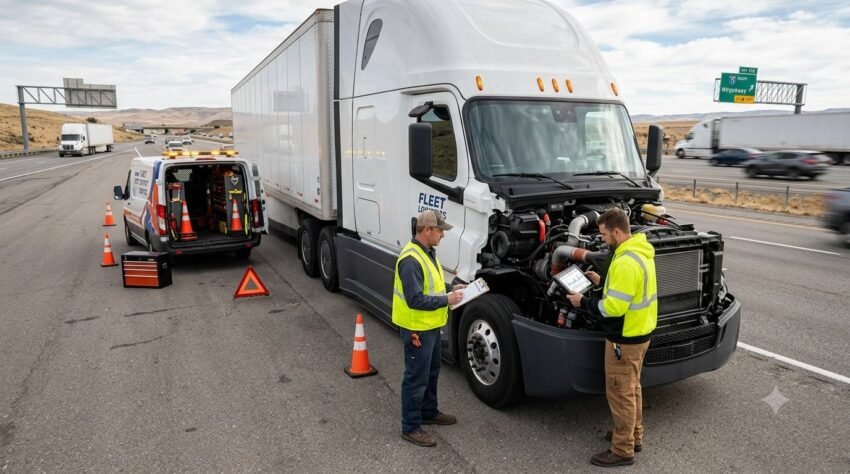
A 44-tonne articulated lorry stopped in a live lane is never just an operational inconvenience. It is a hazard to other road users, a missed delivery slot, a driver whose working day is ticking away, and a customer relationship under quiet strain. National Highways reports that heavy goods vehicles make up roughly a tenth of traffic on its network yet feature in around 19 per cent of incidents that end in death or serious injury. Any sensible breakdown plan therefore has two objectives rather than one: get the vehicle moving, and cut the time it spends as a danger to everyone around it.
The uncomfortable part is that most heavy vehicle stoppages are foreseeable. DVSA enforcement figures for the first quarter of the 2025/26 financial year show that of 3,213 roadside mechanical checks carried out on GB-registered HGVs, 899 ended in a prohibition, a rate of almost 28 per cent. The annual test paints a similar picture, with roughly one in ten lorries failing at first presentation. Vehicle age is the clearest single predictor: HGVs under a year old recorded an initial fail rate of 2.7 per cent, while those aged 12 years or more failed at 24.4 per cent, close to nine times higher.
Decide who is coming before you need them
The most common cause of a long roadside wait is not the fault itself. It is the scramble to find somebody with the right equipment and the right authorisation to attend. A tail lift failure at a distribution park and an overturned tipper on a rural A road at two in the morning are entirely different jobs. Operators who arrange nationwide recovery cover in advance, with agreed heavy lift capability, defined response times and a single number that works at any hour, consistently get vehicles cleared faster than those ringing round at the point of failure. Put the agreement in writing, check what is genuinely covered outside the M25, and confirm who pays for specialist lifting or load transfer before an invoice arrives.
The driver’s first five minutes
What happens in the moments after a warning light or a bang matters more than most training packages suggest. Where the vehicle can still be moved, the priority is to get left and leave the carriageway at the next junction or emergency area, even if that means limping a short distance. On a hard shoulder, the driver should stop as far left as possible, leave by the nearside door, get behind the barrier and only then make calls. If the vehicle stops in a running lane and it is not safe to exit, the advice is to keep seatbelts fastened, switch on hazard lights and call 999.
A laminated prompt card in the cab is far more reliable than memory at three in the morning in poor weather. Include the National Highways number, the recovery contact and a reminder to note the nearest marker post.
Give the recovery operator something to work with
Recovery firms will tell you that the quality of the initial call largely determines how long the job takes. Useful details include gross weight and axle configuration, whether the vehicle is laden and with what, any ADR classification, height and length, whether the unit will still roll and steer, ground conditions if the vehicle has left the carriageway, and a precise location using a marker post or junction number rather than a town name. A vague call often results in the wrong equipment turning up, which can add hours. An accurate one may mean a single vehicle attends instead of three.
Treat every callout as data
Fleets that reduce downtime year on year tend to record the same handful of fields after each incident: the component that failed, the mileage and age of the vehicle, hours lost and total cost. Patterns surface quickly: air leaks on particular tractor units, battery failures clustering in the first cold snap, tyre damage on specific routes. Many of the defects DVSA finds at the roadside, among them lighting, tyres and load security, are precisely the sort a thorough daily walkaround check should pick up first. Feeding recovery data back into preventative maintenance inspection intervals is one of the cheapest reliability improvements available to a transport manager.
The quiet advantage
No operator eliminates breakdowns entirely. The fleets that handle them well are rarely doing anything exotic; they have contracted cover in place, drivers who know the first five steps without thinking, accurate information passed on the first call, and an honest review afterwards. Over a full year that discipline shows up as fewer wasted driver hours, lower recovery bills, better test results and, most importantly, fewer occasions when a stationary lorry becomes somebody else’s accident.