
Key Takeaways
- Arc spray can be used for dimensional restoration, wear resistance, electrical conductivity, and friction-related surface requirements.
- SURFALLOY offers multiple coating and welding processes, allowing the method to be matched to the application rather than applying one solution to every part.
- HVOF coatings are suited to applications requiring dense, low-porosity, wear-resistant surfaces.
- Hard face welding is designed for heavier overlays and rebuilding where a fusion-bonded deposit is needed.
- SURFALLOY lists normal service at two to three days, with expedited options available depending on project requirements.
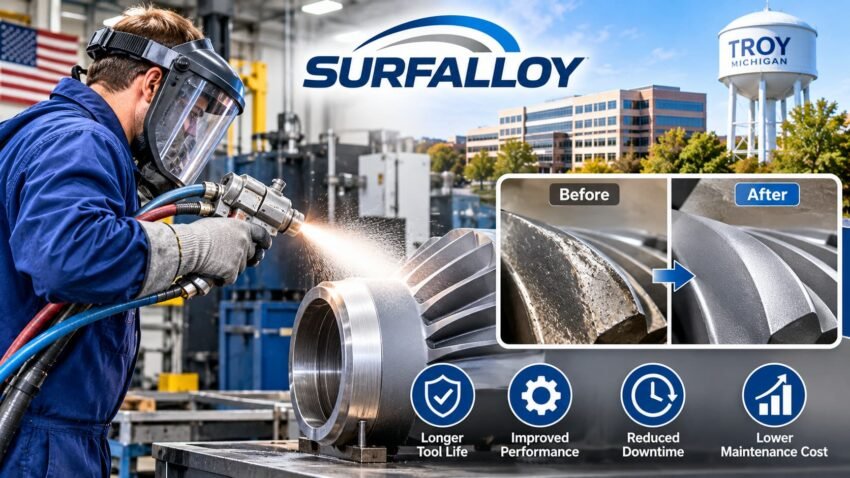
Premature wear can turn a usable shaft, die, seal, roll, or production tool into an expensive source of downtime. SURFALLOY helps manufacturers evaluate worn metal components and select a repair or protection method that fits the part’s material, geometry, operating environment, and performance goal. Its arc spray coating services Troy MI are one option for restoring dimensions and building functional wear surfaces without automatically replacing the component.
Based in Troy, Michigan, SURFALLOY was founded in 1972 and provides arc spraying, HVOF coating, tungsten carbide surface treatment, and hard-face welding. These processes address different problems, from restoring a worn bearing surface to adding a dense carbide coating for applications subject to demanding abrasion or heat exposure.
Why Manufacturers Use Surface Treatments for Worn Parts
Industrial components can lose material through abrasion, corrosion, erosion, friction, impact, or repeated contact. A worn surface may affect fit, sealing, grip, concentricity, or product quality long before the entire part is unusable. In many cases, restoring the functional surface can be more practical than sourcing and waiting for a replacement component.
Thermal spray is a broad category of processes that apply heated material to a prepared substrate. Thermal spraying techniques can be used to modify surface properties, restore worn surfaces, and provide protection against wear, corrosion, erosion, and high temperatures. The right result depends on sound preparation, suitable feedstock, proper coating thickness, and finishing appropriate to the part.
How Arc Spray Coating Works
SURFALLOY’s twin-wire arc spray process simultaneously melts two wires and uses compressed air to propel atomized particles toward the part. Before spraying, the substrate is typically grit-blasted to create a textured surface that helps the deposited material mechanically key into the parent material.
Arc spray is a practical choice for dimensional restoration, wear surfaces, electrical conductivity, and friction surfaces. SURFALLOY states that it can coat outside diameters, flat surfaces, and inside diameters up to six inches. The company also lists high deposition rate, high particle velocity, focused spray control, dense coatings, uniform microstructure, strong bond strength, and relatively low heat input among the process benefits.
Low heat input does not eliminate every risk. Thin materials can still distort during grit blasting or spraying, so part thickness, masking requirements, and allowable dimensional change should be discussed before processing.
Parts That May Be Candidates for Arc Spray Restoration
Arc spray can address many common repair and maintenance challenges, including:
- Shafts and bearings: Rebuilding worn areas that have lost fit or diameter.
- Pump seals: Restoring surfaces affected by friction, leakage, or wear.
- Mixing blades: Protecting or rebuilding areas exposed to abrasive material flow.
- Printing rolls: Correcting surface damage or dimensional loss before final finishing.
- Tools and dies: Repairing selected worn surfaces where the part and operating conditions are suitable.
- Wear plates: Adding protection in areas exposed to abrasive contact.
SURFALLOY lists stainless steel, carbon steel, nickel-chrome, cobalt-nickel-chrome, aluminum bronze, titanium, kirksite, and babbitt among common arc spray alloys. Its FAQ also states that arc spray and HVOF processes can be applied to many metals, including steel, aluminum, brass, bronze, and copper.
Choosing Between Arc Spray, HVOF, Hard Face Welding, and Carbide Treatment
Surface engineering is not a one-process decision. The best option depends on the base material, type of wear, desired thickness, operating temperature, geometry, finishing requirements, and whether the priority is restoration, grip, corrosion resistance, or a heavy-duty overlay.
- Arc spray: Often appropriate for dimensional restoration, wear protection, conductivity, and friction surfaces. It offers a high deposition rate and lower heat input, although thin sections require careful process control.
- HVOF coating: A high-velocity oxygen fuel process used by SURFALLOY for dense, low-porosity carbide-based coatings. It is suited to applications such as shafts, rolls, gate valves, fan blades, turbine vanes, thermal barriers, and wear plates. Because it is a high-heat process, thin materials need extra care.
- Hard face welding: Useful for rebuilding and thicker overlays where a fusion bond is required. SURFALLOY uses Plasma Transferred Arc welding to deposit powdered metal onto the base material.
- Tungsten carbide surface treatment: Intended for compatible tool steel, low-carbon steel, and other iron-based substrates where added hardness, controlled friction, and gripping performance are important.
SURFALLOY’s Tungsten Carbide Surface Treatment
SURFALLOY describes its carbide treatment as an electronically controlled pulsed-arc micro process that metallurgically bonds tungsten carbide to a steel substrate. The company states that the process operates at near-ambient temperatures, helping reduce concerns about warping or embrittlement. It can also be applied to hardened tool areas and reapplied to previously treated parts without stripping the prior SURFALLOY treatment.
According to SURFALLOY, the coating can achieve surface hardness up to 74 Rc and is designed to resist chipping, peeling, and flaking. The company also notes that the coefficient of friction can be adjusted for the application. Reported customer tool-life improvements of two to six times should be understood as customer-reported results, not a universal performance guarantee.
When Hard Face Welding Is the Better Fit
For heavy-duty repairs, SURFALLOY’s Plasma Transferred Arc process creates an ionized plasma column, introduces powdered metal, and forms a liquid puddle that fuses to the base material. This differs from a coating that relies only on mechanical attachment. SURFALLOY states that its hard-face deposits can be applied in a single pass with less than 10 percent dilution and in thicknesses ranging from 0.060 to 0.500 inches.
Typical uses include forging tools, tool and die resurfacing, glass molds, valve rebuilding, mining equipment, hammermills, fan blades, knives, mixing blades, scraper blades, and wear plate overlays. The company lists iron-based, nickel-based, cobalt-based, and tungsten carbide deposit materials.
Turnaround and Project Planning
SURFALLOY lists normal service at two to three days, one-day service for an additional 10 percent charge, and same-day service for an additional 25 percent charge. Actual completion time can vary with part size, geometry, masking, surface preparation, coating selection, required machining, inspection, and current scheduling.
Questions to Ask Before Sending a Part
- What wear mechanism is causing the problem?
- What is the base material, hardness, and required final dimension?
- Does the part need more grip, lower friction, corrosion resistance, or material restoration?
- Will it operate under elevated temperature, impact, or chemical exposure?
- Which areas must be masked, and will finish machining be needed?
- Has the part been coated, heat treated, or repaired before?
- What delivery date is required?
Frequently Asked Questions
Can SURFALLOY recoat a previously treated part?
SURFALLOY states that its tungsten carbide treatment can be reapplied without stripping the existing treatment. For arc spray and HVOF work, the old coating generally needs to be removed before redeposition.
Is arc spray appropriate for every damaged component?
No. The coating process must be compatible with the substrate, part geometry, thickness requirements, service conditions, and finishing needs. A technical review helps determine whether arc spray, HVOF, hard-face welding, or carbide treatment is the most suitable choice.
What information should a manufacturer provide?
Include a drawing or dimensions, base material, photos of the wear area when available, coating objective, operating conditions, masking needs, and required turnaround. That information supports a more accurate recommendation and repair plan.